Leaders from the World Health Organization Regional Office for Africa (WHO AFRO), WHO Headquarters, and other stakeholders invested in the implementation of PEN-Plus met in Geneva on 24 May to discuss PEN-Plus as a key strategy for decentralizing care for severe NCDs and providing the world’s most vulnerable with accessible and affordable health care for chronic conditions including type 1 diabetes (T1D), sickle cell disease (SCD), and rheumatic and congenital heart disease (RHD/CHD).
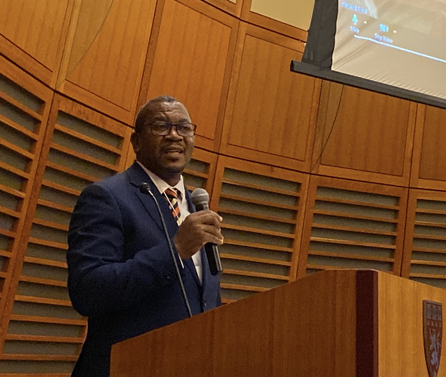
World Health Organization Regional Director for Africa Dr. Matshidiso Moeti gave remarks at the event and expressed her excitement at the opportunity PEN-Plus offers to find ways to integrate care for NCDs.
WHO Regional Director for Africa Matshidiso Moeti addresses PEN-Plus stakeholders at World Health Assembly.
WHO AFRO has developed a regional strategy for PEN-Plus, which is on the agenda to be reviewed and adopted at the August 2022 regional committee meeting.
Speaking as the Co-Chair of the NCDI Poverty Network, Dr. Gene Bukhman highlighted the importance of integration to provide life-saving NCD care in rural and peri-urban communities in low- and lower-middle income countries (LLMICs). Network Co-Chair Dr. Ana Mocumbi explained that PEN-Plus is one such integrated care delivery strategy that leverages linkages between conditions to train mid-level providers in the skills needed to provide chronic care services for T1D, SCD, and RHD/CHD. Speaking on behalf of the Malawi Ministry of Health, Dr. Jones Masiye explained to the group that PEN-Plus was successfully implemented in 2018 in the Neno district of Malawi. Malawi is moving forward with plans to scale-up PEN-Plus nationally by establishing two new clinics in strategically located Salima and Karonga.
Additional speakers at the event were NCDI Poverty Network Voices Advocacy Fellow Anu Gomanju and Helmsley Charitable Trust Program Officer James Reid. Speaking on why support for integrated care delivery models like PEN-Plus are so important, James Reid stressed “No matter where a child is born, however remote, they deserve to live a long fulfilling life. They deserve the right to essential medicine and supplies, and they deserve quality, affordable, and consistent care to treat their NCD.”
Other participants represented the United Nations Development Programme (UNDP), NCD Alliance, Life for a Child, the Pan-African Society of Cardiology (PASCAR), Global Alliance for Rheumatic and Congenital Hearts (Global ARCH), and many other leading financing, policymaking, technical, and advocacy institutions.
PEN-Plus stakeholders will meet again in September 2022 to celebrate the official launch of the PEN-Plus Partnership, which has brought together 42 organizations and 40 individuals to convene regularly and provide technical, policy, advocacy, and financing support to countries implementing and scaling-up PEN-Plus.
If you are interested in supporting PEN-Plus expansion, you may consider joining the NCDI Poverty Network and participating in one of the PEN-Plus working groups. Learn more about Network membership here.
The Center for Integration Science in Global Health Equity (CIS) hosted its inaugural symposium on Thursday, 10 November 2022 at the Joseph B. Martin Conference Center at Harvard Medical School (HMS).
The Center is a joint initiative of the Division of Global Health Equity at Brigham and Women’s Hospital, the Program in Global NCDs and Social Change at Harvard Medical School, and the NCD Synergies project at Partners In Health. The event introduced the Center as a platform for clinicians, researchers, and academics to collaborate in applying integration science to design, implement, evaluate, and bring to scale models for decentralizing services progressively and integrating those services to optimize both health system resources and patient outcomes and well-being.
“The mission of the Center for Integration Science is to accelerate the just redistribution of resources in the interest of global health equity by identifying integrated units of operational effectiveness in health care delivery and scaling their implementation through collective action.”
– CIS Executive Director Dr. Gene Bukhman
Together with the Universidade Eduardo Mondale in Mozambique, the Center also serves as the co-secretariat for the NCDI Poverty Network, a group of 22 low- and lower-middle-income countries (and growing) that was formed in December 2020 to implement the recommendations of the Lancet Commission on Reframing Noncommunicable Diseases and Injuries for the Poorest Billion.
Towards a Science of Integration for Global Health Equity
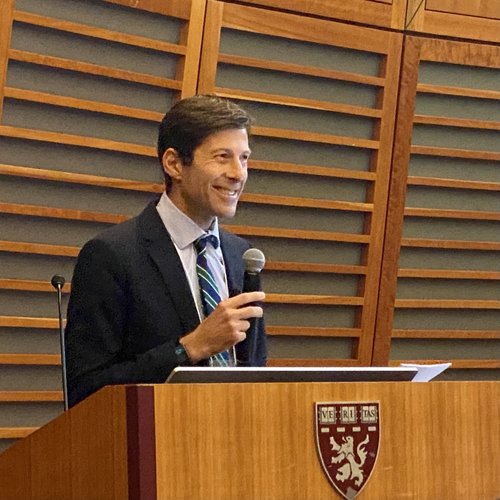
The symposium began with opening remarks from CIS Executive Director Dr. Gene Bukhman and brief introductions from the CIS leadership team.
BWH President Dr. Robert Higgins, BWH Department of Medicine Interim Chair Dr. Bruce Levy, and Partners in Health Co-Founder Todd McCormack also delivered opening addresses at the event.
CIS Executive Director Dr. Gene Bukhman
Dr. Bukhman, who is also Co-Chair of the NCDI Poverty Network, then presented the background of decades of innovation in clinical care, research, and analysis that led to the establishment of CIS. Starting in the 2000s, Bukhman and colleagues at Partners In Health worked with the Ministry of Health in Rwanda to develop a strategy for progressive decentralization and integration of chronic care services at first-level hospitals for multiple non-communicable conditions that were endemic causes of preventable death and suffering among children and young adults.
The Lancet Commission on Reframing NCDs and Injuries for the Poorest Billion, which Bukhman co-chaired with Dr. Ana Mocumbi from Universidade Eduardo Mondlane, identified lack of access to care for severe NCDs as the biggest gap in universal health coverage in low-income countries and proposed a strategy to address it by building integrated care teams of mid-level providers, auxiliaries, and physicians at lower levels of the health system to deliver packages of interventions that require related skills and benefit from shared space and information systems.
Following publication of the Lancet Commission report in 2020, 15 lower-income countries that had conducted parallel analyses through national NCDI Poverty Commissions came together to forge the NCDI Poverty Network as a platform for implementing the Commission’s recommendations. The Network has since grown to include 22 countries, 14 of which are implementing or scaling-up PEN-Plus, a proven integrated delivery model that decentralizes integrated chronic care services for severe chronic NCDs like type 1 diabetes, rheumatic heart disease, and sickle cell disease. In August 2022, the 47 member states of WHO’s African region adopted PEN-Plus as a regional strategy to address severe NCDs.
Dr. Emilio Tostão, Scientific Director, Universidade Eduardo Mondlane
The Center for Integration Science will build on these successes to support further expansion and national scale-up of PEN-Plus and to develop, test, evaluate, and implement other integrated service delivery models
Following Dr. Bukhman’s presentation, Universidade Eduardo Mondlane Scientific Director Dr. Emilio Tostāo provided an overview of the partnership between CIS and Universidade Eduardo Mondlane as the co-secretariat of the NCDI Poverty Network, which works to mobilize resources to support health sector interventions that reduce suffering and prevent death from non-communicable diseases among the world’s poorest children and young adults.
Panelists highlight the power of integration science in advancing global health equity
The Inaugural Symposium featured three panel discussions with leading global health policy makers, patient advocates, researchers, implementers, and academics who discussed how integration science can be (and has been) used to inform the design, implementation, evaluation, and scale-up of integrated service delivery models for interventions prioritized based on equity.
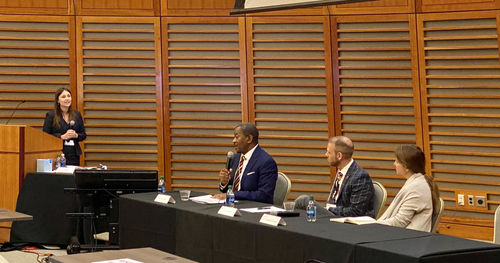
From left to right: Alma Adler, Emilio Tostão, Ryan McBain, and Chantelle Boudreaux
The first panel featured a discussion on integration science as the study of delivery model design, including optimal clustering of tasks among providers and interfaces within and outside of the health system. Panelists included Dr. Tostāo, NCDI Poverty Network East Africa Regional Lead Dr. Wubaye Walelgne Dagnaw, CIS Lead Investigator Dr. Ryan McBain, and CIS Associate Director for Integration Research Dr. Chantelle Boudreaux. CIS Research and Monitoring and Evaluation Director Alma Adler moderated the discussion, which focused on developing techniques for studying the distribution of tasks within health systems, as well as techniques for modelling optimal clustering of these tasks.
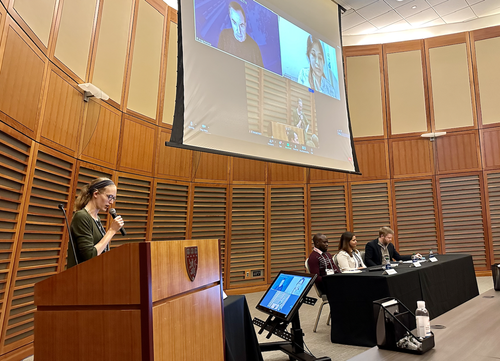
From left to right: Maia Olsen, Moses Echodu, Apoorva Gomber, and Jon Shaffer. Gregg Gonsalves and Ana Gomanju pictured on screen.
The second group of panelists consisting of global health advocates and community organizers discussed how to build a multi-disease social movement in support of integrated care delivery strategies like PEN-Plus. The panelists included Associate Professor of Epidemiology at Yale School of Public Health Dr. Gregg Gonsalves, CIS Type 1 Diabetes and Global Health Equity Research Fellow Dr. Apoorva Gomber, Postdoctoral Fellow of Sociology at Johns Hopkins University Dr. Jon Shaffer, and Voices of NCDI Poverty Fellows Anu Gomanju from Nepal and Moses Echodu from Uganda. The panel was moderated by CIS Advocacy Director Maia Olsen.
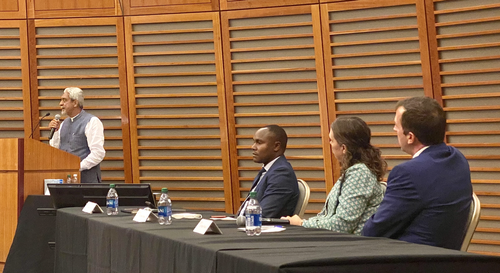
From left to right: Vikram Patel, Gedeon Ngoga, Emily Wroe, and Robert Riviello
In the final panel, Pershing Square Professor of Global Health at Harvard Medical School Dr. Vikram Patel led a discussion about experiences with implementation of integrated delivery models in the areas of chronic care for severe NCDs, acute/critical care, and breast and gynecological care. CIS Training Director Gedeon Ngoga, CIS Director of Programs Dr. Emily Wroe, Associate Professor of Surgery and of Global Health and Social Medicine at Harvard Medical School (HMS) Dr. Robert Riviello, and World Health Organization Regional Office for Africa Cervical Cancer Technical Officer Sharon Kapambwe shared their perspectives and insights during the discussion.
You can read more about CIS and its work here and watch a recording of the event below.
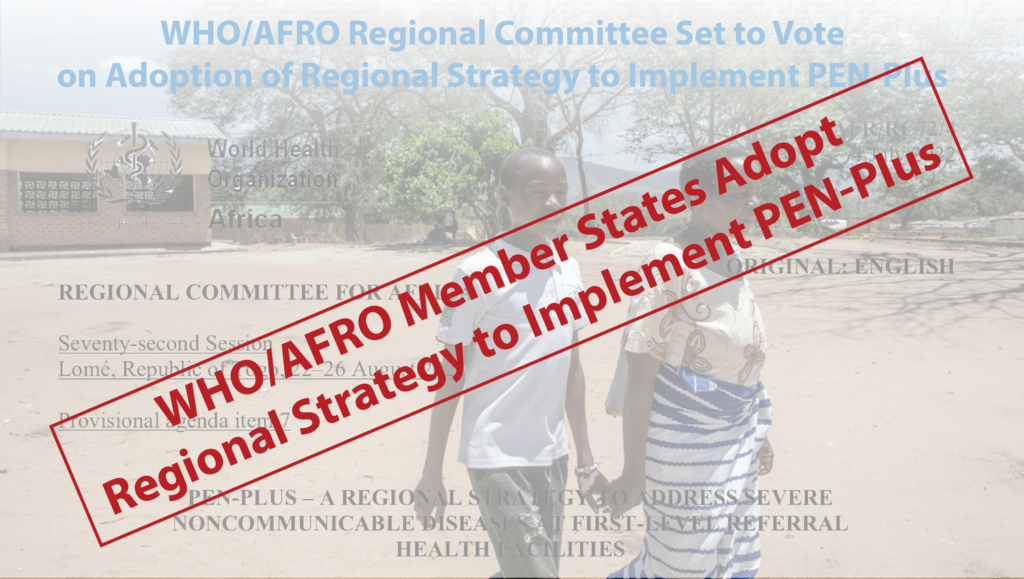
Implementation of this strategy will increase the capacity of first-level health facilities in rural and peri-urban areas to diagnose and treat severe, chronic non-communicable diseases (NCDs) such as sickle cell disease, type 1 diabetes, and rheumatic heart disease. It will also – as the strategy points out – accelerate and strengthen implementation of WHO’s Package of Essential NCD Interventions (PEN) for prevention and management of less severe conditions at primary care level, which is currently being implemented in only 45% of the region’s Member States.
“WHO has been providing support to member states to implement PEN for primary health care in low-resource settings since 2008,” Dr. Benido Impouma, Director of the WHO/AFRO Regional Office’s Communicable and Noncommunicable Diseases Cluster, stated in presenting the resolution. “The region now needs to focus on specific severe NCDs such as type 1 diabetes, sickle cell disease, and rheumatic fever, ensuring that vulnerable populations with these diseases have access to diagnosis and treatment within their communities…. ”
“Implementing PEN-Plus is critical to reducing premature disability and deaths in those living with these diseases [severe NCDs such as type 1 diabetes, sickle cell disease, and rheumatic fever].”
— Benido Impouma, Director Communicable and Noncommunicable Diseases Cluster, WHO/AFRO
Adoption of the Regional Strategy marks the successful culmination of a process that began more than three years ago, when WHO/AFRO and the Rwanda Ministry of Health hosted a regional consultation on WHO PEN and PEN-Plus in Kigali, at which Prebo Barango of WHO/AFRO and collaborators from the secretariat of the Lancet NCDI Poverty Commission and NCDI Poverty Network presented a preliminary draft of the regional PEN-Plus strategy.
Since that consultation, WHO/AFRO has worked with the NCDI Poverty Network, UNICEF, the Helmsley Charitable Trust, and other partners to support national scale-up of PEN-Plus in Malawi; initiation of PEN-Plus clinics and training sites in eight other countries in the region – Ethiopia, Kenya, Uganda, Tanzania, Mozambique, Zambia, Zimbabwe, and Sierra Leone; and finalization of the draft Regional Strategy that has now been adopted.
Now, with adoption of the regional PEN-Plus strategy, WHO/AFRO has established ambitious goals to have 50% of Member States rolling out PEN-Plus services to district hospitals by the year 2025, 65% by 2028, and 70% by 2030.
“The adoption of the WHO PEN-Plus resolution and strategy by countries in the African region shows their commitment to helping those afflicted by severe chronic NCDs. These conditions include diseases such as type 1 diabetes, rheumatic heart disease, sickle cell disease, and others that have previously fallen through the cracks of global policy and action,” NCDI Poverty Network Co-Chairs Gene Bukhman and Ana Mocumbi said, following the vote. “Now, the NCDI Poverty Network’s PEN-Plus Partnership is organizing a movement to support these countries financially so that the poorest are not left behind,”
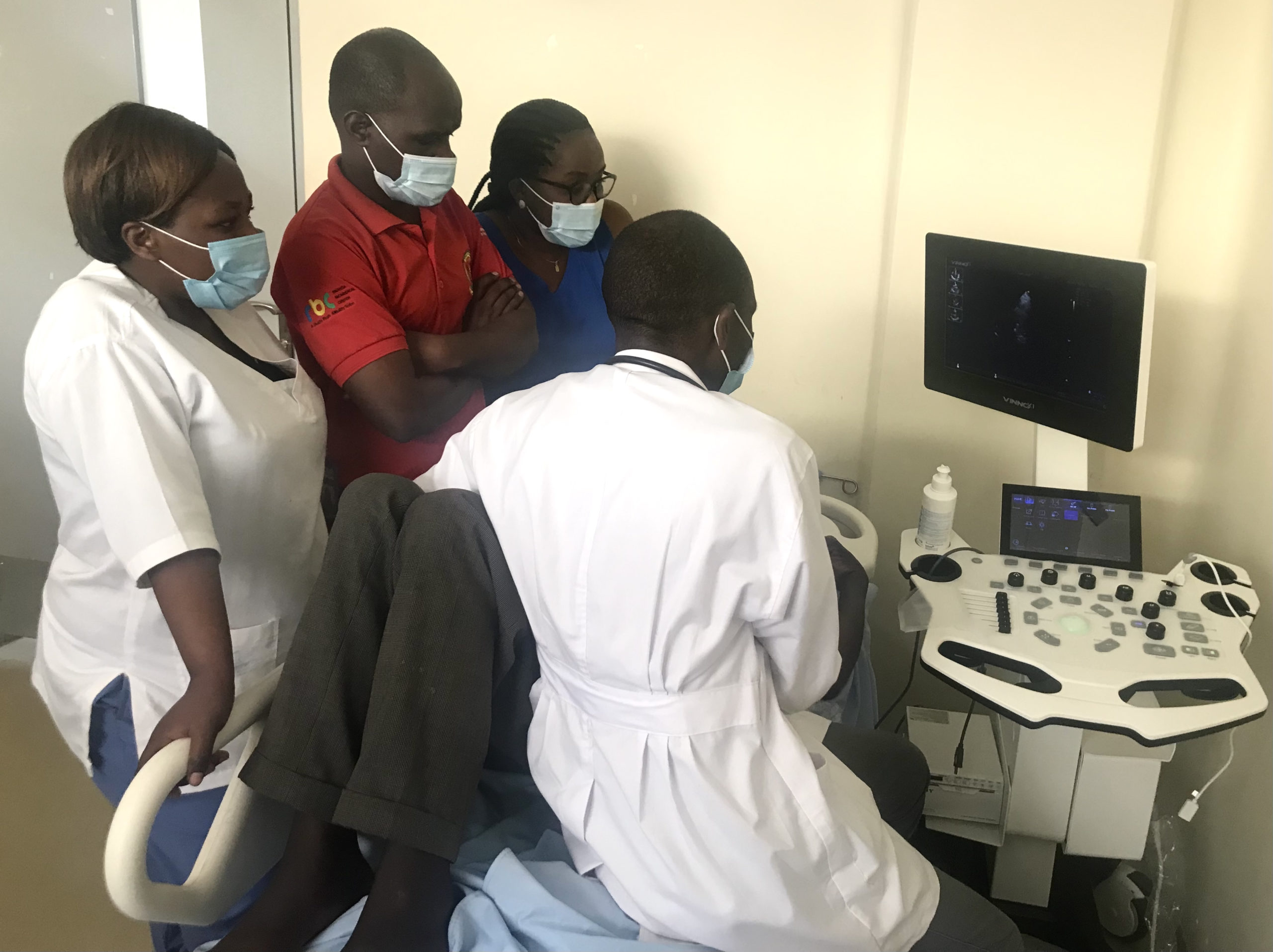
Participants in PEN-Plus heart failure management course evaluate and discuss cardiac ultrasound images.
A training model that combines in-person classroom instruction with a digital, e-learning platform has been successfully piloted in Rwanda to train PEN-Plus nurses and physicians in the knowledge, skills, and competencies to diagnose and treat heart failure. The training model and corresponding learning materials are being developed and tested as part of a PEN-Plus curriculum that can be adapted by NCDI Poverty Network countries as they initiate and scale-up implementation of PEN-Plus services.
Initial survey data and focus group feedback suggests that the new training model is an effective way to convey knowledge about the causes, symptoms, and treatment protocols for heart failure, and to acquire and practice skills required for diagnosis and treatment. Rwanda will continue to utilize the new training model as a means of scaling-up PEN-Plus nationally, and plans are being made to test the same cardiology training model in Liberia and Malawi.
After completing two weeks of online training modules, 20 trainees from five rural, district hospitals spread across the country met with six facilitators at the Partners in Health training site in Rwinkwavu between 1-5 November for the first in-person component of the training model. After spending that week practicing new skills and discussing case studies as a group, pairs of newly trained nurses and physicians returned to their hospitals with master trainers for an additional week of supervised in-person training and mentoring.
The online portion of the training, developed by the e-learning and training team of the NCDI Poverty Network Secretariat, covered topics such as cardiac anatomy and physiology, causes of heart failure, and ways to diagnose and treat cardiomyopathy, congenital heart disease, and right heart failure. The online course also included knowledge checks as well as a pre- and post-course exam. Additional advanced modules covering prosthetic heart valves and anticoagulation medication are currently under development.
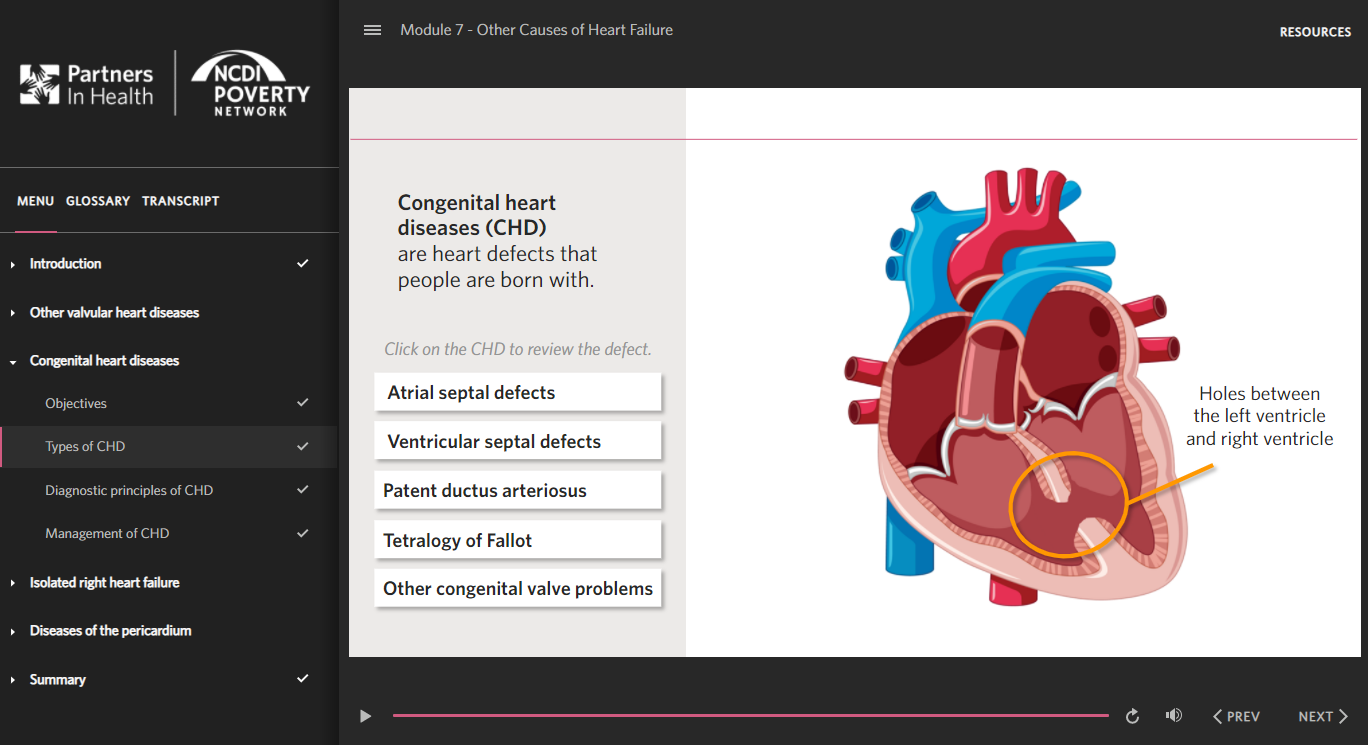
Congenital heart failure is one of the topics covered in the eight online heart failure training modules.
The in-person portion of the training focused on skills-based learning. By first introducing topics online as part of a flipped classroom model, in-person instructors can focus their attention on leading hands-on training exercises in which trainees apply their knowledge in practice. During the in-person portion of the training model, participants learned and practiced new skills, like how to perform and interpret an echocardiogram, and discussed challenging cases with mentors.
Participant feedback and e-learning data are currently under review. The results will be used to improve both the online and in-person portions of the training model and will assist the NCDI Poverty team as they develop training modules for other conditions covered by PEN-Plus, such as type 1 diabetes and sickle cell disease.
“The highlight of this training is identifying a successful training model that could potentially be used to scale-up PEN-Plus in other Network countries,” said Dr. Sheila Klassen, a cardiologist who works with the NCDI Poverty Secretariat on curriculum development and training. “Having this training go so well and know we could possibly replicate with similar success is very exciting.”
A recently published study found that expanding an existing HIV and tuberculosis (TB) CHW program in the Neno district of Malawi to include non-communicable diseases (NCDs) and other conditions reduced the number of patients defaulting from chronic NCD care each month by approximately 20% while maintaining the already low default rate for HIV patients.
The stepped-wedge cluster randomized controlled trial evaluated expanding an existing HIV and tuberculosis (TB) CHW program to include NCDs, malnutrition and TB screening, as well as family planning and antenatal care (ANC). The trial was successful in improving antenatal care attendance and rates of default from chronic care without affecting the default rate from HIV care, which was already covered by the previous program with very strong results.
The research article published in BMJ Global Health can be read in its entirety here.
CHWs are community members outside of the formal nursing or medical profession who are trained to provide health education, screen for diseases, make referrals, and sometimes deliver basic health services. For vulnerable populations living in resource-poor settings, CHWs are a vital link to primary care.
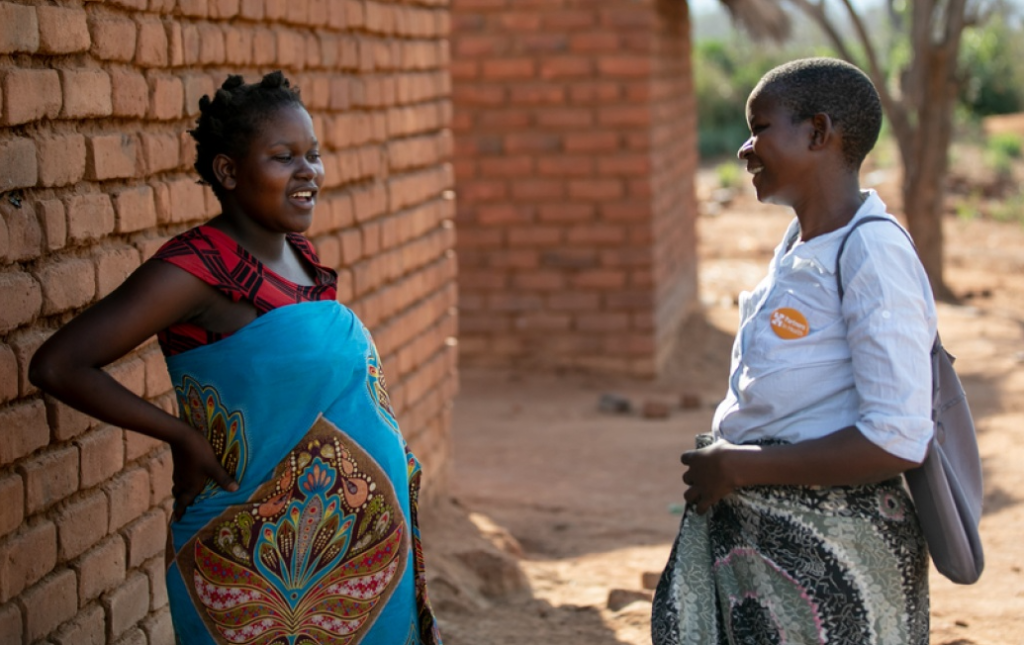
Eliza Kazembe, left, talks with CHW Grace Mgaiwa, who supported Kazembe with antenatal care throughout her pregnancy. — Photo by Karin Schermbrucker / Slingshot Media. Copyright Partners In Health
The study evaluated a household model in which every household in the rural district of Neno received at least one visit per month from a CHW who had received five days of training to introduce the skills needed to focus on NCDs, including hypertension, diabetes, asthma, epilepsy, and mental health conditions. While many previous studies have proven that CHW programs improve health outcomes in low and middle-income countries for single health issues, such as HIV and malaria, this study evaluated the efficacy of a CHW program focused on a broad range of health areas, including NCDs. For people living with chronic health conditions, the routine access to treatment, monitoring, and counseling provided by CHWs helps ensure that patients remain in care, prevents diseases from becoming worse, and keeps patients out of the hospital.
Dr. Emily Wroe, an author of the study, explained that the CHW program was able to successfully expand to address the health needs of NCD patients while continuing to deliver excellent results for HIV care because of the way it was designed and implemented.
“On top of ensuring that each CHW was assigned a manageable caseload and had the support they needed to succeed, CHWs were chosen based on their relationship to the community,” Wroe explained. “The CHWs selected lived in the village they were serving and had the trust of their patients. Because of these relationships, the CHWs were very effective when following up with patients and checking in after missed appointments, which improved the retention of patients enrolled in NCD care.”
In addition to creating positive health outcomes for the community, the trial helped the CHWs involved and their communities by creating jobs and career pathways.

 Implementation of this strategy will increase the capacity of first-level health facilities in rural and peri-urban areas to diagnose and treat severe, chronic non-communicable diseases (NCDs) such as sickle cell disease, type 1 diabetes, and rheumatic heart disease. It will also – as the strategy points out – accelerate and strengthen implementation of WHO’s Package of Essential NCD Interventions (PEN) for prevention and management of less severe conditions at primary care level, which is currently being implemented in only 45% of the region’s Member States.